Showing posts with label Russia. Show all posts

Monday, September 28, 2015

Why Putin is so afraid of "export" of democratic revolutions

Pro-Kremlin news agencies already headline Putin's UN address with titles like "Putin to UN: Export of so-called ‘democratic’ revolutions continues globally". In his speech Putin made every effort to turn democratic movements of last decade into puppets driven by US and its allies. So why is he so afraid of democratic revolutions?

Because he is the one who still lives the life of Kadafis, Mubaraks, Husseins of the world and he witnessed how they ended up during these years. His neighboring states like Kyrgyzstan, Tajikistan, Georgia, Ukraine are too constant reminders of the fate awaiting certain presidents of the former Soviet Union states.

If you still don't quite understand how Putin consolidated power inside Russia just look at the party representation across governors of Federal Subjects in Russian Federation. Then compare with similar governments of States in Germany (both are federations according to their constitutions). United Russia ("Единая Россия") is party Putin represents (even though he is formally nonpartisan), and nonpartisan governors are de facto proxies of "United Russia" in most (if not all) cases.
Sources:


Sunday, December 14, 2014

Why Russian Crisis of 2014 is Not the Same as Crisis of 2008-2009?

Some consider current crisis in Russia as no different from one suffered during and after financial crisis of 2007-2008. In fact, the culprits are falling oil prices and the total collapse of large financial institutions repeat themselves: oil prices are falling again and Western sanctions against Russia simulate the latter. The effects on Russian economy look like before too: Russian currency - ruble - keeps falling against dollar and Russian economy is heading for recession - just like in 2d half of 2008. But is it really the same kind of crisis for Russia?

This simple comparison bar chart tries to address this question by looking at 3 things: how much oil prices fell, how much ruble lost against dollar, and how much reserves Russia had at the beginning of each crisis.


The crisis of 2014 is still unfolding which makes this chart even more telling. Ruble fall is already far ahead of total loss in 2008-2009 (red bars). At the same time, this year oil prices fell just a fraction of total loss in 2008-2009 (blue bars). To top it off, Russia had 100,000 million USD more in reserves before crisis in 2008 than it had in August of 2014 (green bars). I suspect there are other different things at play in 2014. What are they?

Data (updated on Monday, December 15th):
2014: from June 20th when oil peaked to Monday, December 15th. Reserves Central Bank held in 2014 were the largest on July 1st.
2008-2009: rather conservative dates from July 3d (when oil peaked) to February 18th, 2009 (when ruble began stabilizing along with oil prices). Reserves were largest on August 1st.
Oil prices: for WTI.

Sources:
1. WTI Daily Prices
2. RUB to USD Historical Exchange Rates Daily
3. USD and Gold Reserves by Russian Central Bank

Friday, August 8, 2014

The Good, the Bad and the Ugly: Where Russia Stands on Banned Foods

Russia responded to sanctions by banning western food imports. Supposedly the government hand picked products that should not immediately harm Russian economy and consumer.

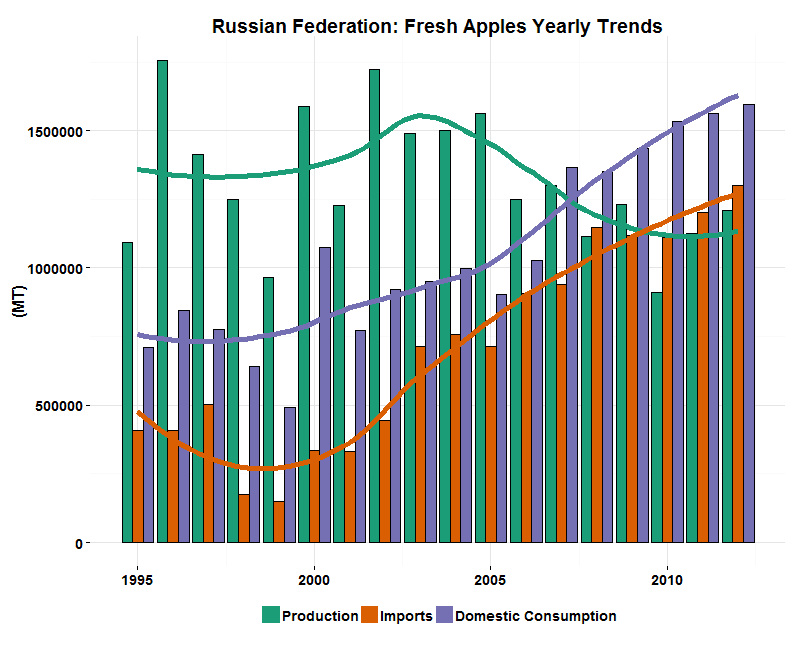
Big question in Russia is deciding between production or replacing importers or both at least for one year while ban is active. Below I plot trends of Domestic Consumption, Production and Imports by Russia for last 20 years or so for some of the banned food groups. These are total numbers across all importers and my goal was to see when Russia can make leaps towards production and where it will likely look for new import partners. I also hope that economists may find this information helpful to assess impact on Russian consumer and economy.

The Good


Chicken, pork, and turkey meats are doing great. For all 3, growing demand is met with growing production and at expense of diminishing imports. Turkey industry in Russia is simply experiencing Renaissance - too bad it's relatively unpopular among consumers. All 3 are good choices to ban imports to further convince domestic producers to invest.

Fish and seafood demand is fully met by production, but picture is distorted due to variability of products inside this food group. Probably, imports of higher end products such as Norwegian salmon will not be easily replaced.
 
I suspect that Milk (non-dry) is not import heavy product so there is nothing to worry about (on both ends of the food ban vs. sanctions chain). We'll see quite different picture with dry milk later.

The Bad

Everyone in Russia talks about beef from Brazil and Argentina nowdays and this chart clearly shows why. Both import and production trend lower with decreasing demand with import not very far below production. Russia will be looking for replacement of banned beef elsewhere, probably in Latin America.


All 4 dairy food groups above show clear sign of replacing production with imports in last 10-20 years with 2 Dry Milk groups at worst. Import trends go up despite stagnating demand. Russian producers of milk products and retailers will be looking for new importers unless the government will reverse trend in falling domestic production.

The Ugly


Fresh fruits will come from Turkey or China or somewhere but not from Russia. The only group that shows production growth is grapes but it's clearly too low.

I picked pistachios because almost everyone loves them and they were on the list of banned foods. Good luck to find them in Russian stores in a few weeks and my sincere sorry to high-end chefs who will miss them from appetizers to desserts.

The Cherry Orchard 


Fresh Cherries (both sweet and sour) is a food group which associates with "The Cherry Orchard" - the last play by Anton Chekchov. You can read the play or look at the chart... and then read the play.

On more food groups and countries involved into Russia's Food Ban see my interactive infographics. Conclusions made are my subjective opinion. I welcome any comments and/or corrections.

Sources: Index Mundi  and United States Department of Agriculture.

Friday, March 28, 2014

Word clouds of Putin Address

Yet another turn of events took place today with Putin phoning Obama to seek diplomatic solution to the international standoff over Ukraine. Neither side expressed much excitement so far, but dialogue during crisis is better than couple of monologues.

Meanwhile what drove Putin to reach out to Obama? Maybe he feels it's the time he holds all the cards? While easily guessing his cards are Crimea, military buildup on the border, and continuing instability in Ukraine, what would be the bargaining about?

I will try using simple text analysis give another perspective on Putin's campaign in Crimea. Russian president doesn't give speeches or  press-conferences often but always exceptionally prepared. There were 3 relevant appearances by Putin in last couple of months before and during Ukrainian crisis (all are official translations from his site):

  1. News conference following EU Summit on January 24th.
  2. Press-conference with media representatives to answer questions with regard to the situation in Ukraine on March 4th. 
  3. Address by President to State Duma on Crimea on March 18th.
So what is the Address on Crimea about:
Not surprisingly it refers to Ukraine, Crimea and Russia the most. These words could be excluded without loosing any insight: 
Now, cloud becomes all about will and people (supposedly applied to RussianUkrainianCrimean). Has anything changed since EU Summit when Putin made his address? One way to answer this is to place both transcripts into the text corpus and run TF-IDF statistic on the terms. This time our cloud is based on the TF-IDF scores (minimal frequency of term per document is 3) for the address and will reflect both frequency in the Address and importance compared to EU Summit (that is all other documents in the corpus):
The words above stand out when compared to EU Summit text. It's no surprise that Sevastopol didn't sound in January, but nor were Kosovo, residents, and law. To make it more convincing let's throw into the mix Putin's press conference on March 4th when he broke silence on Crimea. Now the text corpus includes 3 documents and this is the cloud of the highest TF-IDF scores for the Address document:

Again there are Sevastopol and city, but also importantly Russians, NATO, millions, ethnic, reality, Tatars, borders, and USSR are the words that stand out compared to what Putin said before. It is a clearly a mix of his concerns, goals, and, well, realities, but, it could be also about symbol of Russian glory - Sevastopol - at least to some degree? After checking his speech it is clear that he referred to Sevastopol each time Crimea, but there was one place where this city mentioned alone: 
"I simply cannot imagine that we would travel to Sevastopol to visit NATO sailors."
Would Putin roll back and yield to international condemnation? Very unlikely, but I cannot imagine at all he will give Sevastopol back.

Since Sevastopol was used along with Crimea which was removed from analysis the cloud below is version of last with Sevastopol excluded. Word clouds are always open to interpretation so I leave it here for the reader to make their own conclusions:

Thursday, September 1, 2011

Good Luck, President Medvedev!

Finally President Medvedev said it. Wait is over. No more 2d term for him. No more questions - skip election press conference, relax, do crazy things, vacation all you want, rename Red Army to White, move permanently to Sochi or Miami. Nothing can hurt you anymore because president of Russia never says something like vodka is evil and wine is as good as water or juice.

There are way too many problems with this.

Firstly, beer is the main fighter of vodka in Russia. Never mind beer became an appetizer to a lot of vodka drinkers: it will be a hard sell for wine to overtake beer.

Secondly, dry wine demands some sophistication from its consumers because wine is a foodie drink. Anywhere you go wine goes side by side with local type of food: Chèvre and Sancerre or Schnitzel with sauerkraut and German Riesling or BBQ and Zinfandel. Pairing typical Russian food is a challenge (if you have a good idea for pelmeni with sour cream please let me know).

Next goes simple price/reward ratio: choosing between wine with 11-14% alcohol level and vodka with 40% alcohol level for half or less the price. It’s no brainer.

But don’t stop there. How about selection: there are literally 100s types of different wines – not even brands – which leaves uneducated consumer daunted and lost. On top of that two decent, affordable and well known sources of wine for Russian consumer are Moldova and Georgia – both are banned for import for pure political reasons.

With all these problems I wish President Medvedev good luck. Because some day wine might turn out to be a cure for vodka-loving Russia. But I don’t see just 2 things today: how Medvedev can be a president after this and how Putin can jump on a wine loving band-wagon when he becomes president again. Because even fantastically overinflated credit Putin has won’t be enough to fight vodka in Russia. But maybe, just maybe, it is the one idea that can turn a lot of things around in this country…